In recent years, with the rapid development of wearable and bioelectronic devices, providing flexible systems with energy solutions that are efficient, sustainable, and highly conformable has become a major technical bottleneck in the field. Thermoelectric devices, which can convert temperature differences into electrical energy, are considered ideal candidates for self-powered wearable systems. In addition, thermoelectric devices can achieve cooling when electrically driven, offering important potential for wearable cooling applications. Traditional inorganic thermoelectric materials (such as Bi₂Te₃ and PbTe) are widely used due to their excellent thermoelectric performance, but their intrinsic brittleness and lack of stretchability make them difficult to adapt to the dynamic deformations required by flexible wearable devices. While organic thermoelectric materials offer better flexibility, they still face challenges such as irreversible deformation under stretching, performance degradation, and high bulk modulus that prevents conformal contact with the skin, limiting stable power generation or cooling during human movement.
To address these challenges, Professor Ting Lei’s team at Peking University’s School of Materials Science and Engineering has developed a thermoelectric elastomer with high thermoelectric figure of merit (ZT), excellent stretchable resilience, and low modulus — a “thermoelectric rubber” material (Figure 1). This breakthrough overcomes the long-standing difficulty of simultaneously optimizing the mechanical, electrical, and thermal properties of thermoelectric materials, enabling efficient capture and conversion of human body heat. The work opens new avenues for continuous self-powered wearable devices and solid-state cooling. The findings are published in Nature under the title “N-type Thermoelectric Elastomers.”

Figure 1: Design Strategy for N-type Thermoelectric Elastomers
Three Key Innovations Overcome the “Mechanical–Electrical–Thermal” Performance Trade-Off
To realize the “thermoelectric rubber” material, Professor Ting Lei’s team proposed three crucial strategies: uniform nanoscale phase separation, heat-triggered crosslinking, and directional doping.
1.Nanoscale Phase Separation Control: By screening rubber materials compatible with conjugated polymers using Hansen solubility parameters, the team constructed a bulk, uniformly distributed semiconductor polymer nanofiber network, significantly enhancing the carrier mobility of the semiconducting polymer (Figure 2a–c).
2.Heat-triggered Crosslinking: Introducing azo-based crosslinkers reduced the system’s modulus while crosslinking the two polymer types. This strategy endowed the material with ultra-high elongation (>850%) and maintained over 90% elastic recovery at 150% strain, comparable to conventional rubbers (Figure 2d–e).
3.Directional Doping: By selecting appropriate dopants, the semiconductor nanofibers were directionally doped, improving doping efficiency. This simultaneously enhanced electrical conductivity and the Seebeck coefficient, while showing a unique strain-induced conductivity enhancement behavior.
These strategies not only improved the material’s mechanical properties but also significantly enhanced its thermoelectric performance. The improvement arises from two main factors: the nanoscale phase-separated structure boosts carrier mobility, increasing conductivity and Seebeck coefficient, while conventional rubber encapsulation of conjugated polymers enhances interfacial phonon scattering, lowering overall thermal conductivity. The resulting material achieved a thermoelectric figure of merit (ZT) of 0.49 at room temperature (300 K), approaching or even surpassing the performance of existing flexible and plastic inorganic thermoelectric materials (Figure 2f–g).
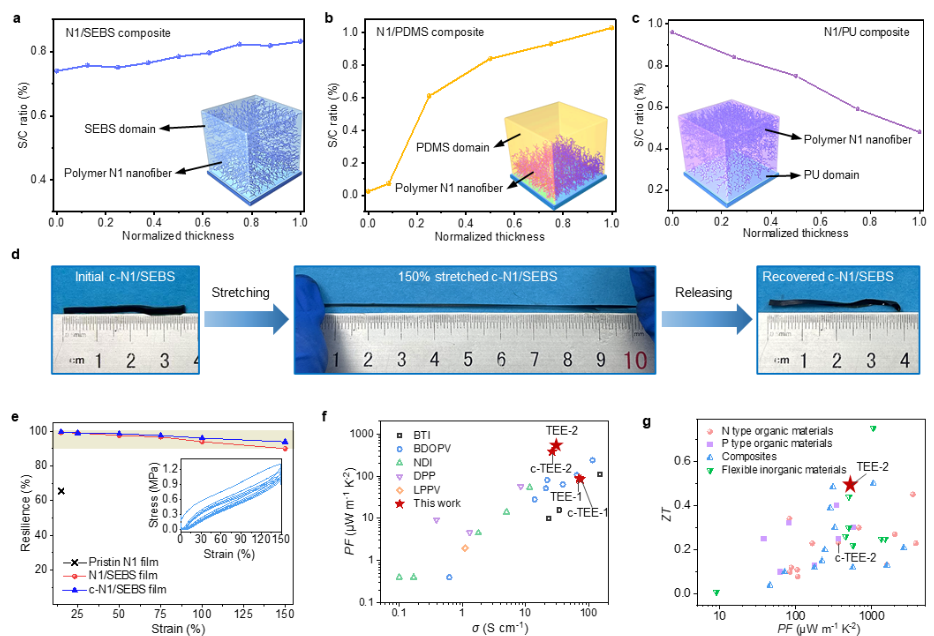
Figure 2: (a–c) Morphology of bulk nanoscale phase separation in blends of conjugated polymer N1 with insulating elastomers, (a) SEBS, (b) PDMS, and (c) PU.
(d) Stretch–recovery behavior of the N1-based thermoelectric elastomer.
(e) Cyclic tensile performance of N1 and N1-based thermoelectric elastomers at different strains (inset shows stress–strain curve of the elastomer).
(f) Comparison of power factor between the thermoelectric elastomer and reported N-type organic thermoelectric materials.
(g) Comparison of ZT values between the thermoelectric elastomer and reported flexible/plastic thermoelectric materials.
Integration of Elastic Materials Enables the First Stretchable Thermoelectric Module
Building on high-performance thermoelectric elastomers and stretchable electrode technology, Professor Ting Lei’s team constructed an out-of-plane π-type elastic thermoelectric module, successfully harvesting body heat and providing stable power supply (Figure 3). The module features an integrated design that eliminates the complex interconnects required by conventional rigid thermoelectric devices, achieving adaptive conformal contact with the skin. At the same time, it maintains a high fill factor and low interfacial thermal resistance. This structural design not only ensures excellent thermoelectric conversion efficiency but also represents a significant breakthrough in wearability and adaptability to dynamic deformations, providing a sustainable energy solution for wearable electronics and biosensors.

Figure 3: (a) The module attached to human skin; (b) Finite element analysis of strain distribution when the module is attached to the human elbow; (c) Continuous voltage generation of the out-of-plane π-type thermoelectric generator using the temperature difference between human skin and the environment.
This research marks a significant advance in wearable energy harvesting technology. By innovatively and efficiently harnessing body heat, it provides a new solution to the persistent power supply challenge in flexible electronics and propels flexible energy harvesting technology into a new stage of co-optimized high efficiency and high conformability.
Article Information: Postdoctoral researcher Kai Liu (now Professor at the School of Polymer Science, Qingdao University of Science and Technology) and PhD student Jingyi Wang are co-first authors, and Professor Ting Lei is the sole corresponding author. Peking University served as the first author institution, with Qingdao University of Science & Technology as the second. Collaborators include Professor Jing Hua’s team at Qingdao University of Science & Technology, Academician Yunqi Liu—Researcher Yunlong Guo team at the Institute of Chemistry, Chinese Academy of Sciences, Researcher Zhong’an Di’s team, and Professor Jian Pei’s team at Peking University. This work was supported by the National Natural Science Foundation of China, the Beijing Outstanding Young Scientist Fund, the Peking University High-Performance Computing Platform, the Materials Processing and Testing Center at Peking University, the Molecular Materials and Nanofabrication Laboratory (MMNL) at Peking University’s School of Chemistry and Molecular Engineering, and the Shanghai Synchrotron Radiation Facility.
Article link: https://www.nature.com/articles/s41586-025-09387-z