Solar interfacial evaporation offers a promising pathway to reduce the dependence of distributed seawater desalination on centralized energy supplies and large-scale infrastructure, with its core challenge lying in the efficient conversion of solar radiation into usable heat at the evaporation interface. Covalent organic frameworks (COFs), featuring precisely designable molecular structures and tunable pore channels, provide a critical material foundation for photothermal conversion processes. However, previously reported COFs mainly absorb light in the ultraviolet and short-wavelength visible regions, with insufficient utilization of long-wavelength visible and near-infrared light. This limitation, compounded by radiative dissipation of excited-state energy and heat diffusion to the surrounding environment, severely constrains effective heat generation and interfacial evaporation performance. Therefore, broadening spectral response, enhancing non-radiative relaxation, and suppressing heat dissipation represent key scientific hurdles that must be overcome to improve photothermal seawater desalination efficiency.
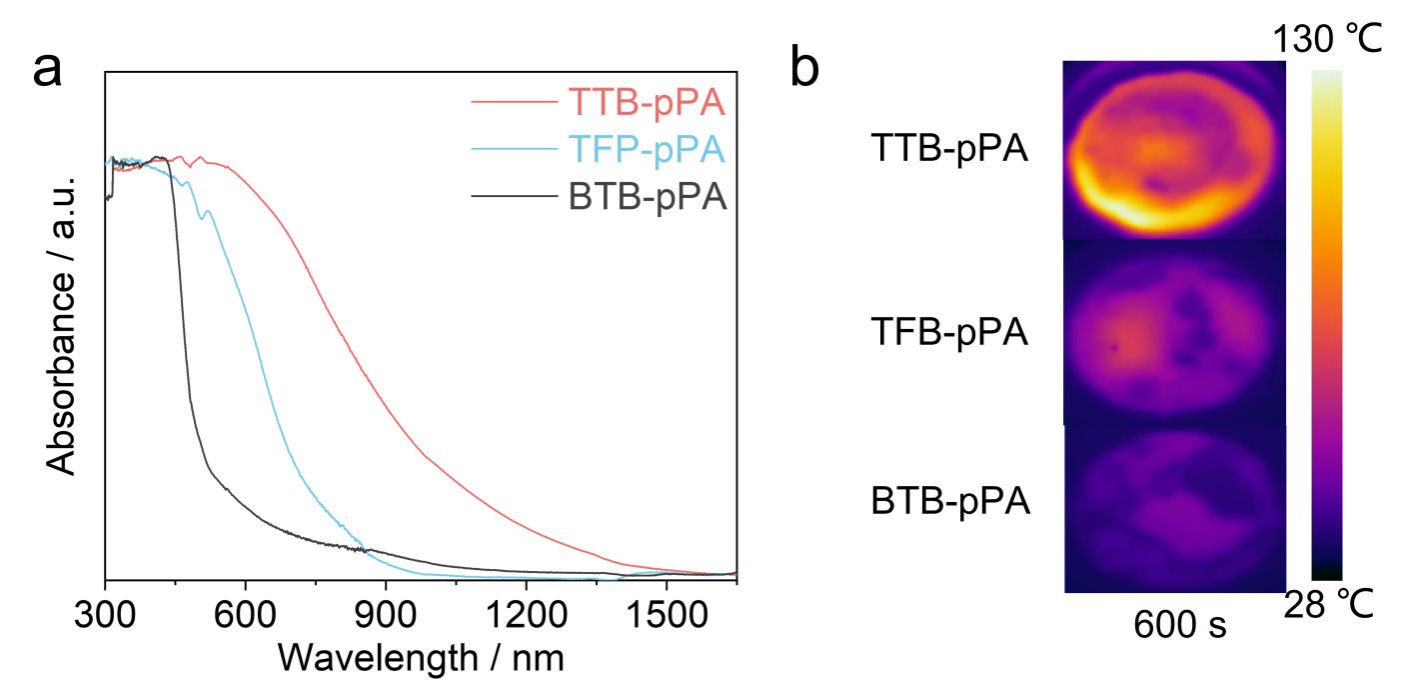
To tackle this challenge, Prof. Shaojun Guo’s team and collaborators proposed a Cl-atom-mediated molecular design strategy for broad-spectrum photothermal materials. Using 2,4,6-trichlorobenzene-1,3,5-tricarbaldehyde (TTB) and p-phenylenediamine (pPA) as building blocks, they synthesized a novel TTB-pPA COF via an imine condensation reaction. The team found that chlorine atoms participate in regulating the framework’s electronic structure, achieving an ultra-broad spectral absorption range of 200–1500 nm that covers the ultraviolet, visible, and near-infrared regions (Figure 1a). Under 1 sun illumination, the surface temperature of TTB-pPA COFs rose to 125.3 °C within 60 seconds, significantly higher than that of COFs constructed from benzene-1,3,5-tricarbaldehyde and p-phenylenediamine (BTB-pPA COFs, 60.7 °C) and COFs constructed from 2,4,6-trihydroxybenzene-1,3,5-tricarbaldehyde and p-phenylenediamine (TFP-pPA COFs, 85.3 °C) (Figure 1b).
The research findings were published online in Nature Water on September 17, in an article entitled Covalent Organic Frameworks with Ultra-broad Band Absorption for Efficient Solar-driven Water Evaporation.Paper DOI: https://doi.org/10.1038/s44221-026-00687-w
In the same issue, Nature Water ran a News & Views commentary titled When ultrabroadband absorption meets solar evaporation by Prof. Enquan Jin of Jilin University and co-authors. The commentary observes that the significance of this work lies in both its molecular design rationale and real-world performance. By tightly coupling the optical and thermal properties of covalent organic frameworks to their molecular structure, the study is expected to advance solar seawater desalination from empirical material screening to mechanism-guided design, treating light harvesting, energy dissipation and water transport as interconnected parameters for holistic optimization. The commentary further affirms the system’s effective ion rejection capability and application potential demonstrated by long-term outdoor tests, noting its deployment in practical water purification processes. It also highlights that the deep integration of materials chemistry, optical physics and thermal engineering charts a critical direction for the development of solar water purification (Figure 5).Commentary DOI: https://doi.org/10.1038/s44221-026-00692-z